
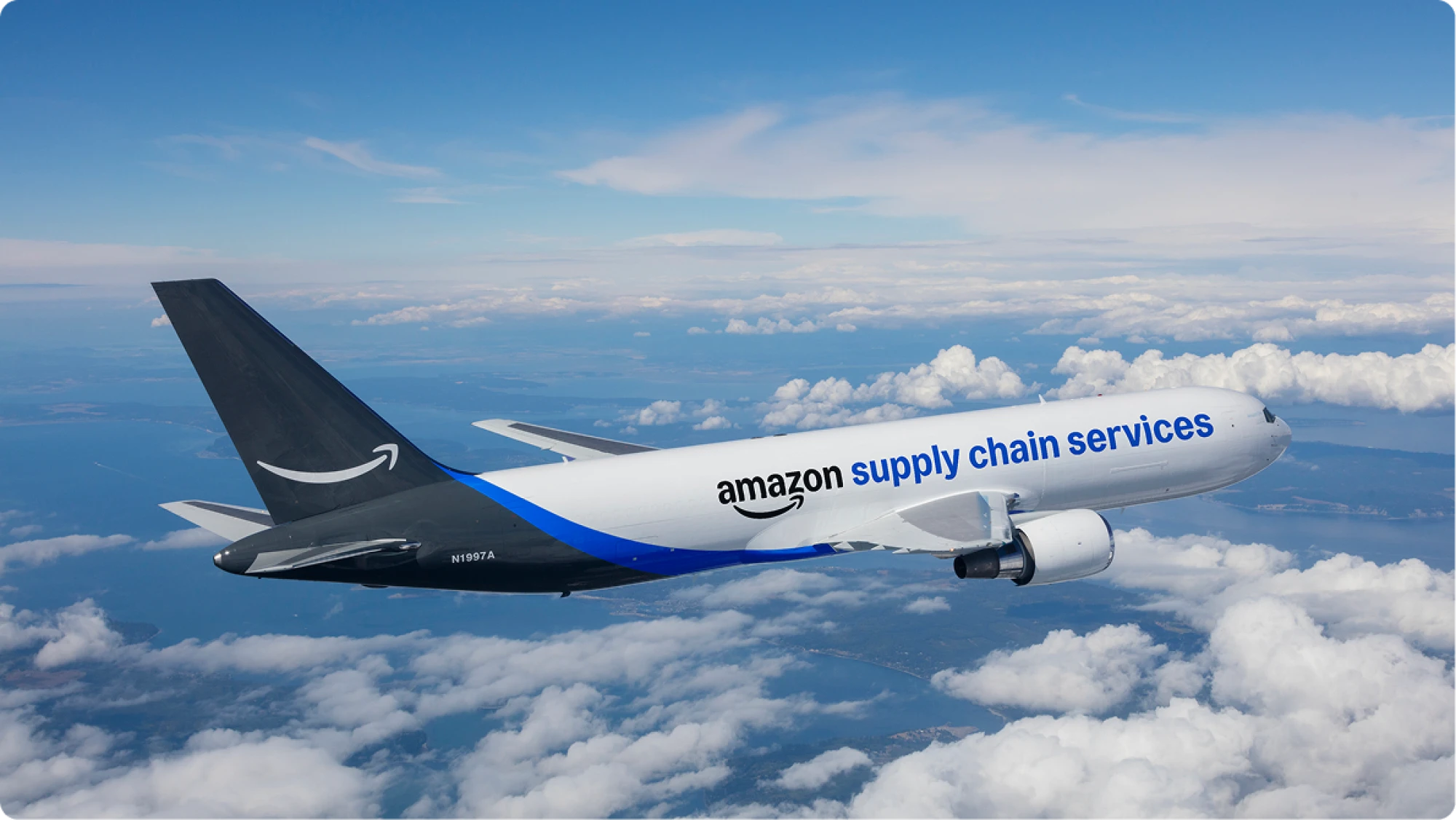

What is Amazon Supply Chain Services (ASCS)?
Pretty much the full logistics stack. Amazon Supply Chain Services includes:
- Full truckload, LTL, and intermodal transport
- Air freight
- China-to-U.S. inbound shipping and customs clearance
- Parcel delivery
- Warehousing and inventory distribution
In other words: one ecosystem, one operator, one giant pipe moving inventory from factory floor to customer doorstep.
The strategy is familiar. It mirrors Amazon’s approach with Amazon Web Services: Amazon built the infrastructure for itself first, then decided to monetize the excess capacity. Same playbook as AWS.
Why brands are considering Amazon’s logistics network
For growing brands, it makes a lot of sense. Many operations teams today are managing disconnected systems, multiple providers, and constant coordination overhead. If Amazon Supply Chain Services can genuinely unify freight, storage, fulfillment, and last-mile delivery into one operational flow, that removes a huge amount of friction.
And for certain businesses, especially high-volume eCommerce shippers and omnichannel brands, that simplicity could create meaningful operational gains. But convenience and control are not the same thing.
The risks of centralizing your supply chain
The biggest question isn’t whether Amazon can execute logistically – they can. The biggest question is whether businesses are comfortable centralizing that much operational visibility with a single provider.
Amazon says customer data from ASCS won’t be used for sourcing, inventory, or pricing decisions inside its retail business. Fine. That’s the official line.
But many brands will still hesitate before giving Amazon complete visibility into:
- inventory levels
- replenishment patterns
- shipping velocity
- regional demand
- operational weaknesses
Would brands be comfortable with handing that much supply chain visibility to a company that also competes with them on the shelf?
And what about capacity issues? The potential for challenges could compound ahead of the peak holiday shipping season. If capacity tightens during Q4, who gets priority? Marketplace sellers, or standalone logistics customers?
Amazon can simplify logistics, no doubt. But sellers also need to think about dependency, fee risk, and data sharing risk. Convenience is valuable, but only if the full economics still make sense.

How Amazon Supply Chain Services could disrupt the logistics industry
Will this disrupt the logistics industry? Absolutely. But not in the dramatic “Amazon kills logistics” way people online love to post about.
This isn’t Amazon versus 3PLs. It’s integrated systems versus fragmented ones. That’s the real pressure point.
- Smaller carriers competing mainly on price will likely feel it first. Amazon Shipping could absolutely squeeze parts of the parcel market.
- LTL carriers should be somewhat more protected, since I don’t see Amazon building hub-and-spoke terminal networks anytime soon.
- 3PLs and freight brokers are in a difficult spot because Amazon’s scale and data give it advantages in exactly the kinds of services they provide… but I don’t feel like this will kill them off. AZ operates through standardization to achieve efficiencies at scale. 3PLs who can differentiate from the “Amazon offering” by offering flexibility, curatorship, personal relationships and geography specific knowledge will still have their place.
Amazon’s real advantage: Data and predictive logistics
Amazon’s real competitive advantage has never only been transportation capacity. It’s data infrastructure. If they start commercializing its forecasting and inventory positioning capabilities, that changes the game entirely. Imagine knowing where to place inventory before demand spikes — not after orders start flowing in.
That’s where logistics stops being reactive and becomes predictive. And frankly, a lot of operators are still struggling with the reactive part.
So… Is Amazon Supply Chain Services right for your business?
Wrong question. The better question is: does the economics-to-control ratio work for your business?
Because Amazon will absolutely make logistics easier. The real test is whether it still makes financial and operational sense once all the fees, dependencies, and tradeoffs are fully visible.